PropWise
Automated valuation models for commercial property — and the hard work of making them trusted
2024
PropTech
Portfolio screening time from 3 weeks to 2 days; models used in 340+ live transactions to date
The problem
PropWise serves fund managers and institutional investors who make decisions on commercial property portfolios — office, retail, and logistics assets across the Nordics. Their clients were using traditional RICS-methodology appraisals for every asset in a portfolio review cycle, each one taking 14–21 days and costing 3,000–8,000 EUR. For a 60-asset portfolio review, that was a €350,000 and 6-week exercise done quarterly. PropWise's founders believed this could be accelerated with ML, but two previous attempts by internal data science teams had failed — not because the models were inaccurate, but because analysts refused to use them. The models produced a number with no explanation of how they arrived at it, and no institutional analyst is going to stake a recommendation to a fund committee on a number they can't explain. There was also a data problem: commercial property sales are not public record in all Nordic jurisdictions, meaning transaction data had to be licensed from multiple proprietary sources with inconsistent schema and coverage gaps.
Our approach
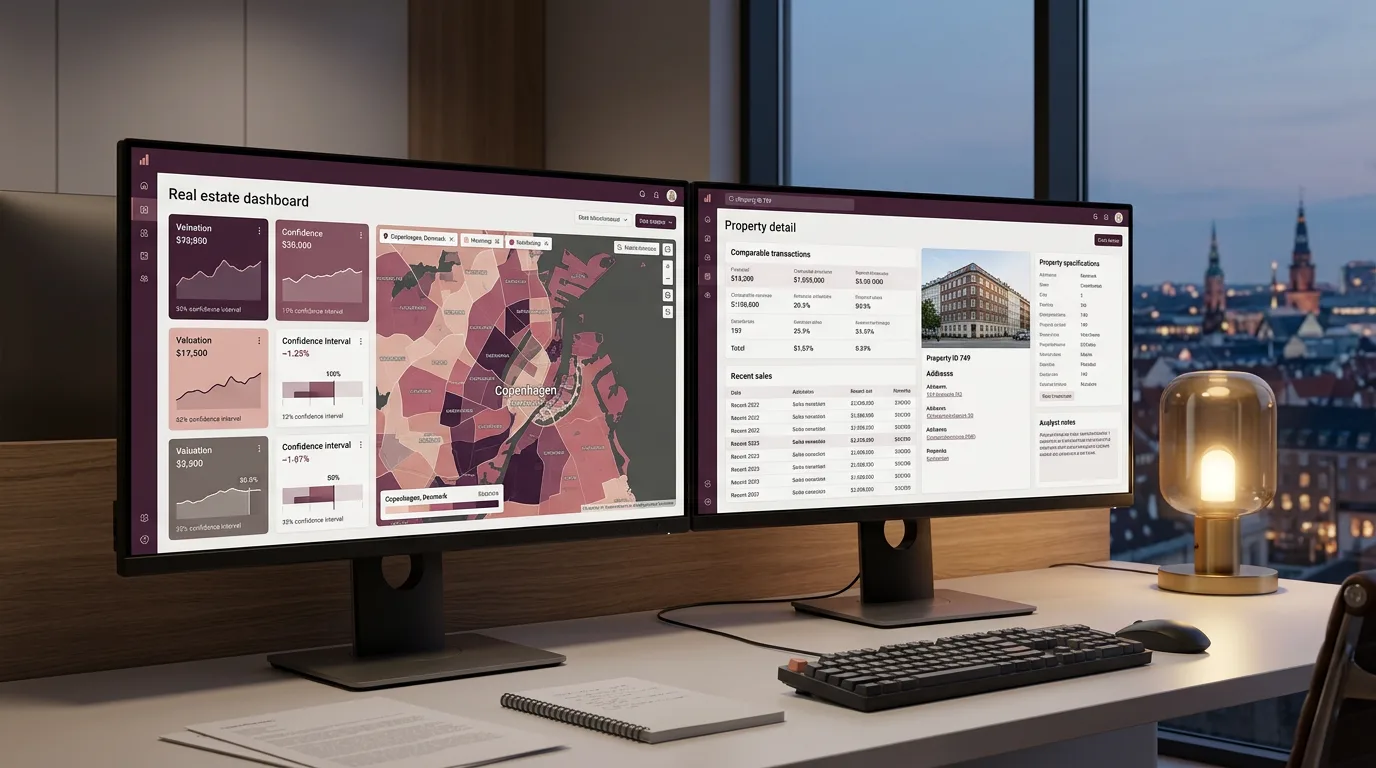
We began with six weeks of user research focused entirely on how analysts currently build a valuation argument — not just the final number, but the narrative they present to investment committees. Every feature in the platform was then mapped to a step in that existing workflow. The valuation output shows a central estimate alongside a confidence interval and the five most influential factors in the model's output, each with its comparable transaction evidence. Analysts can override any input assumption and see the valuation update in real time — the model becomes a tool they control, not a black box they trust or don't. The data pipeline ingests and normalises feeds from four transaction data providers, a planning authority API for zoning changes, and satellite-derived footfall estimates for retail assets. Model training uses a temporal split to prevent data leakage — an issue we found in the internal models that had been built previously. Valuation accuracy is tracked continuously against actual sale prices as transactions close.
The results
Portfolio screening time has dropped from three weeks to two days for a standard 60-asset review. The models have been used in 340 live transaction decisions since launch. Median absolute percentage error against observed sale prices is 6.1% across all asset classes — better than the previous internal models, though retail assets in secondary locations remain harder to call accurately (11.3% MAPE). The two metrics that mattered most to PropWise's clients are ones we didn't initially measure: analyst confidence (tracked through a post-review survey, now at 78% 'comfortable using as primary input') and time spent on explanation versus analysis in committee presentations, which PropWise reports has shifted substantially toward analysis.
Tech Stack
Want similar results?
Let's discuss how we can help you achieve your goals.